
Mushroom Foraging in Hampshire
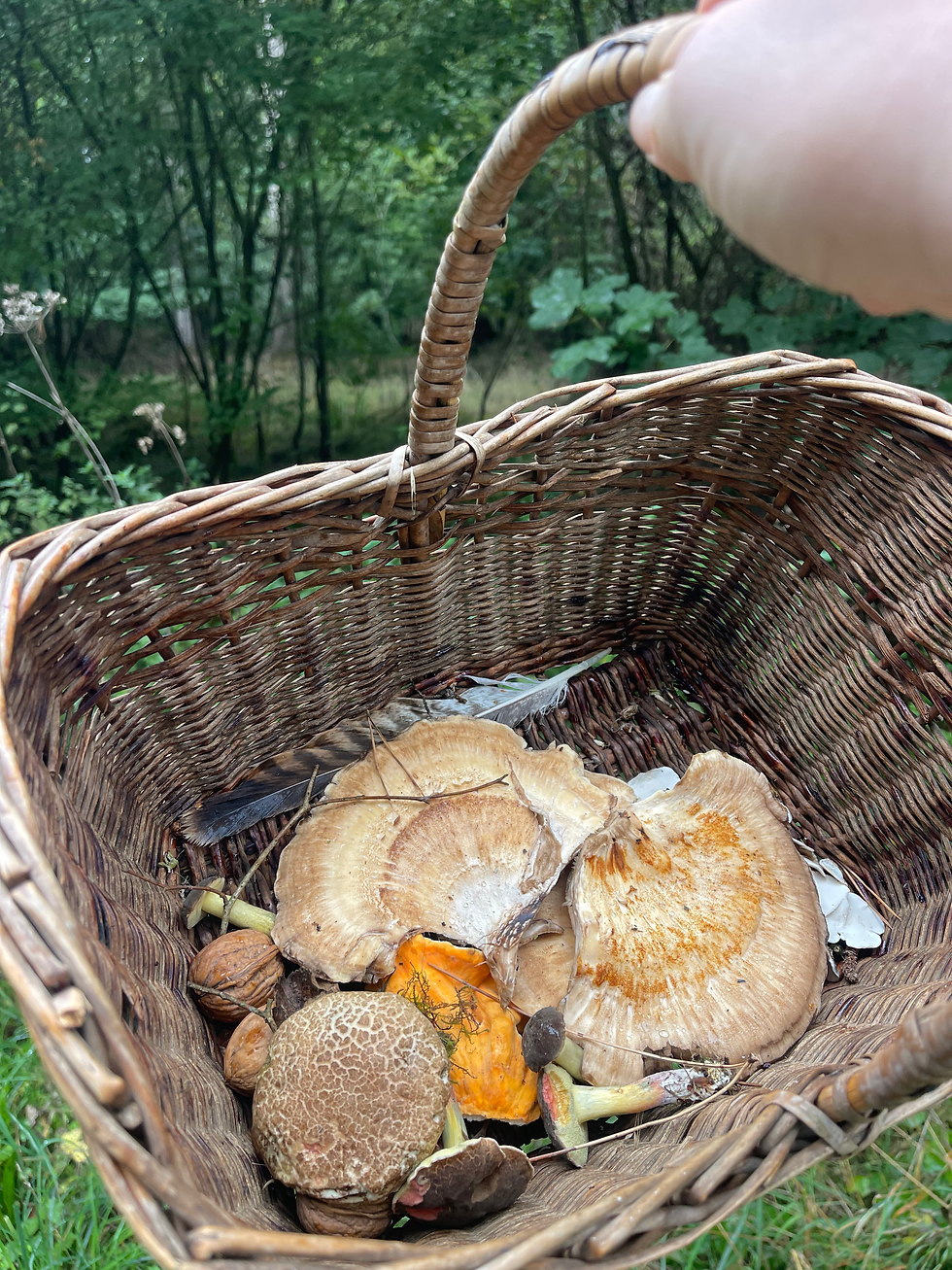
Autumn is one of the most exciting times of year to forage in the UK. The woods change almost overnight. The light dims, the air turns damp and earthy, leaves begin to fall, and the woodland floor feels alive with beautiful, brilliant, and sometimes strange looking things.
Autumn is the season where mushrooms take centre stage.
On my autumn foraging walks across Hampshire and Wiltshire, fungi are always one of the things people are most fascinated by. Is it their weird and wonderful appearance, the promise of finding something tasty, or their complex communication systems? One day a log looks completely ordinary, and the next it is covered in bright yellow shelves of chicken of the woods. A patch of grass suddenly reveals a puffball. The base of a tree becomes home to great dark fans of giant polypore.
Some mushrooms are delicious, some are medicinal, some are useful to observe, and some are dangerous. This is why learning safely, slowly and in person can make such a difference.
Here are some of the wonderful mushrooms you might come across in the UK in autumn.

Chicken of the Woods
Chicken of the woods is one of the most exciting mushrooms to spot because it is almost impossible to miss when it appears in full colour. It grows in bright yellow to orange brackets, usually on trees or dead wood, and has a soft, almost meaty texture when young.
As the name suggests, it is often compared to chicken, and it can be wonderful cooked into curries, pies, stir-fries or simply fried in butter.
As with all wild mushrooms, correct identification is essential, and it should be cooked properly before eating. It's also worth noting that it has been reported 1 in 10 people can be allergic to this mushroom, so always try a little to see if you have any stomach upset before eating a whole meal.

Giant Polypore
Giant polypore is another impressive autumn find. It often grows in large overlapping clusters at the base of trees, creating great layered fans of mushroom. When young and tender, parts of it can be used in cooking, though it becomes tougher and more bitter as it ages. The older mushrooms can be dried and used for stock.
Foraging mushrooms is not only about knowing the mushroom itself, but also
understanding where it grows, what it grows on, and how it changes as it matures.

Beefsteak Fungus
Beefsteak fungus is one of the most visually striking mushrooms in the UK - I found my first one this season, and boy was I excited. It often grows on oak or sweet chestnut and has a deep red, fleshy appearance, hence the name. It can almost look like a piece of meat attached to a tree, which feels wonderfully strange the first time you see it.
It has a sharp, slightly acidic flavour and can be sliced thinly, cooked, or used in small amounts where that tangy quality works well.

Boletes
Boletes are a fascinating group of mushrooms, and many have pores underneath rather than gills. This group includes some excellent edible species like ceps, but also others that should be avoided, so careful identification is key.
When people think of autumn mushroom foraging, boletes are often part of that dream: sturdy stems, rounded caps, woodland floors, moss, leaf litter and that deep savoury promise of mushroom season. They can be beautiful in simple cooking, especially fried with butter, garlic and herbs, or dried for later use.

Turkey Tail
Turkey tail is a beautiful bracket fungus, often found growing in layered fans on dead wood. It gets its name from the bands of colour that can look a little like a turkey’s tail feathers.
It is not usually used as a culinary mushroom in the same way as puffballs or chicken of the woods, but it is widely known for its traditional use in teas and extracts. Even when I’m not gathering it, I love finding turkey tail because it is such a good reminder that fungi are not just food. They are part of the woodland’s recycling system, breaking down wood and feeding life back into the forest.

Slippery Jack
Slippery jack is another autumn mushroom often found around pine trees. It has a glossy, sticky cap, especially in damp weather, which makes the name feel very appropriate.
This is a mushroom that can be great to learn because it encourages you to pay attention to habitat. Are you near pine? What is the cap texture like? What does the underside look like? These details matter, and they help build confidence over time.
Some people remove the sticky skin before cooking, and as with many mushrooms, texture
and preparation make a big difference.

Puffballs
Puffballs are one of my favourite beginner-friendly mushrooms to learn about, though they still need careful checking. When young and edible, they should be pure white all the way through when cut open. If they have started to turn yellow, brown or show any internal structure, they are NOT something to eat.
Cooked well, puffballs are lovely. They can be sliced and fried, breaded, added to soups, or used almost like a mushroomy sponge for butter, garlic and herbs.
Autumn Mushroom Foraging Is So Special
Autumn mushroom foraging is not just about filling a basket. In fact, some of the most valuable finds are the ones you do not take home at all.
It is about learning how fungi fit into the landscape. Which trees they grow with. Which habitats they prefer. How rain, temperature and season affect them. How quickly they appear, change and disappear again.
It teaches patience and attention. You begin to walk differently. You scan tree trunks, fallen branches, mossy banks, field edges and old stumps. The woodland stops being background and becomes a living, changing map.
Foraging also brings us back to an old skill that many of us have lost touch with. It is a way of understanding food beyond the supermarket. It is seasonal, mindful, practical and grounding.
A Note on Mushroom Safety
Mushroom foraging should always be approached with care. Never eat any wild mushroom unless you are completely confident in its identification, and never rely on apps alone. Some edible mushrooms have dangerous lookalikes, and some species can cause serious illness.
This is why I always teach not only what you can eat, but also what to avoid. Knowing the dangerous plants and fungi is just as important as knowing the delicious ones.
If you are new to mushroom foraging, start slowly. Learn a few species well. Look at habitat, season, smell, texture, gills or pores, spore colour and the surrounding environment. And when in doubt, leave it out.
Join Me for an Autumn Foraging Walk
If you would love to learn more about mushrooms and seasonal wild food, my autumn foraging walks in Hampshire and Wiltshire are designed especially for beginners and curious food lovers.
We spend time outdoors learning how to identify seasonal plants and mushrooms safely, what to avoid, how to harvest responsibly, and how wild ingredients can be used in the kitchen. These walks are not about rushing through the woods with a basket and hoping for dinner. They are about slowing down, looking properly, and building real confidence.
Autumn is such a beautiful time to begin. The hedgerows are full, the woods are changing, and the landscape has so much to teach us.
My foraging walks are available to book through my website. Come and spend a morning outside, reconnect with nature, and discover the wild food growing all around us.

